
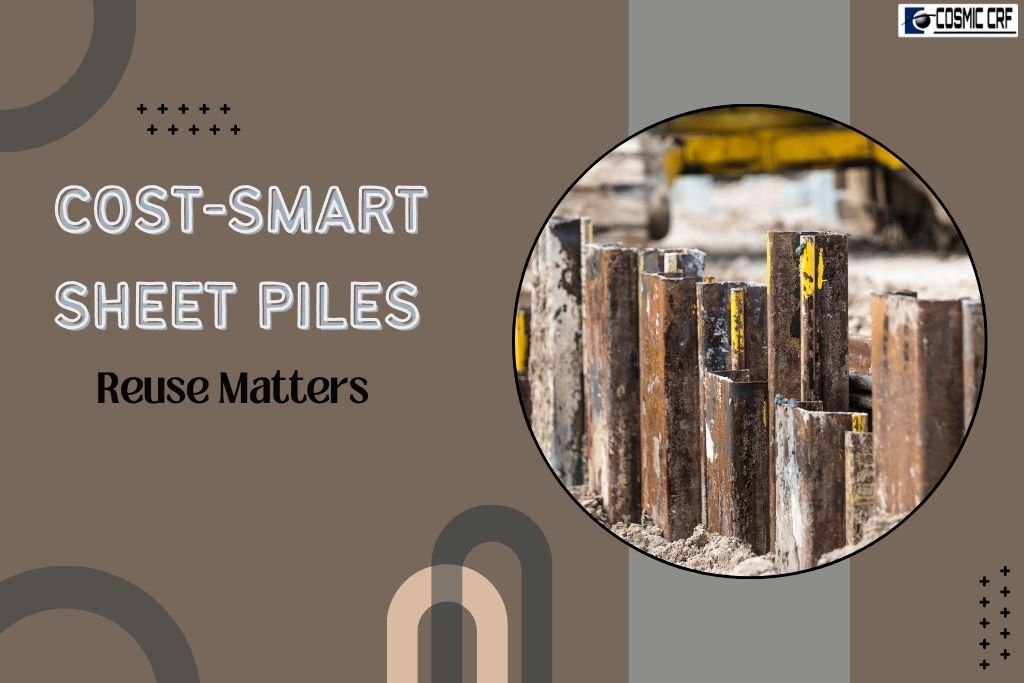
Not every steel part is meant to return. But in piling systems, reuse is often a real option, especially when materials, handling, and design support it.
Still, reuse isn’t free. It takes planning from day one.
If you’re comparing quotes without factoring lifecycle cost, you’re only seeing half the picture.
Here’s where reuse pays off and what shapes its success.
Sheet Condition After Extraction Determines Viability
A reused sheet pile needs more than just intact interlocks. Straightness, surface loss, and retained stress all influence how usable it is in the next round.
Driving and extraction both change the sheet’s shape. Tension builds up during embedment and release, especially in rocky or mixed soil layers.
If the extraction team twists or over-pulls, the profile might distort. Even a slight wave or bend forces costly correction or field rejection later.
Planning reuse means thinking about how you’ll extract and store each section, not just how you’ll drive it.
Reuse Adds Value Only When Steel Grade Supports It
Some steel grades behave better across cycles. Elongation, ductility, and weld resilience matter more when the profile needs to return to service.
Lower-carbon steels with higher elongation values show fewer signs of cracking after bending stress.
At the forming stage, mill-level stability in chemistry and grain flow improves the sheet’s ability to take multiple drives without fatigue damage.
If you’re reusing piles across high-load zones, you’ll want to assess behavior under repeated embedment (not just initial yield strength).
Planning for Extraction Starts at Installation
Designing for reuse means placing extraction in the plan from day one. That means pre-driving tests, coating choices, staging sequence, and even how many joints the crew will interrupt during install.
A profile installed in the wrong order may wedge itself between fixed structures or run too deep for standard extraction rigs.
Some reuse-friendly practices include driving off a guide frame, using driving shoes, and choosing release-friendly sealants or coatings.
The cost of reuse shrinks when removal is smooth and predictable.
Field Handling Makes or Breaks Reusability
The best-formed profile loses value if it’s dragged, thrown, or pinched during unloading.
Reusability depends not just on mechanical properties but also on how the profile moves between locations. Scratches, flattening at the crown, and bent interlocks often happen during yard handling, not in soil.
Crews trained on profile orientation and handling angles extend the life of every section. Even the slings, stacking method, and transport cradle influence whether a sheet sees one life or many.
Cleaning, Inspection, and Rework Carry Real Cost
Before reuse, each sheet must be assessed. That means cleaning off rust, checking interlocks, trimming damaged ends, and possibly recoating.
Reconditioning costs sit between new steel and raw scrap value.
If you’re running high reusability, you’ll need a vendor or partner with clear incoming inspection criteria and in-house capacity for light corrections.
The value lies in consistency. If rework steps vary, reuse turns uncertain and starts to carry hidden risk. A fixed inspection process turns scrap probability into usable material planning.
Projects That Benefit Most From Reuse
Sheet reuse fits best in temporary structures: cofferdams, shoring walls, trench boxes, flood barriers. These projects benefit when steel returns to stock quickly, minimizing procurement lead times.
But even permanent works can justify reuse when the same profile reappears across locations.
In rail, irrigation, or port maintenance, standardizing section types enables field teams to cycle stock rather than order fresh.
A high-reuse ecosystem doesn’t happen by chance. It’s engineered into how you design, store, and inspect sheet piles over time.
Final Thoughts
Thinking in lifecycles shifts focus from just specs to how well a profile performs across jobs.
Shape retention, clean extraction, and forming stability decide whether a sheet pile serves once or several times.
At Cosmic CRF, we design with that arc in mind. Our forming methods support reuse, and our traceability helps you track value over time.
If reuse matters to your project planning, reach out and we’ll help you build around it.